Inflation Can Be Ended Permanently by Activist Media and Politicians, Starting Now
Support The 20% Plan.
James Anthony
October 11, 2025
According to short-term thinking [1], Republican constitutionalists should claim that the ongoing invasion by illegals [2] would be ended given new statutory rules. Given that crumb, Republicans should approve a new budget, voters will elect Republicans, and that will be good.
But the existing constitutional statutes already aren’t being executed. Only state-government people [3] and ultimately presidents can stop the invasion. Electing Republican Progressives [4] won’t stop the ongoing invasion.
Also, electing Republican Progressives won’t stop the ongoing inflation [5], [6]. This won’t satisfy voters.
It’s the tyranny, stupid [7], [8]!
Nearly all statutes are unconstitutional because they (1) mislead, (2) use unenumerated powers, (3) delegate, (4) grab executive power, (5) grab judicial power, or (6) are noncritical, complex, or long, or help make the total corpus of law incomprehensibly complex or long [9].
This is royal administrative tyranny [10].
Constitutional statutes are easy to recognize. They consist only of rules [9] and penalties [11]. People obey them without even reading them if people simply respect others [12].
Executives have the constitutional duty to independently interpret the constitutionality of their every action and to never take any action that’s unconstitutional [10].
On day one, a constitutionalist executive would order a full stop on executing everything. On nearly everything, this would be doing exactly what’s right.
From there, he would quickly triage each department, agency, and chartered organization. He would close each one that’s wholly unconstitutional. On each one that’s partly unconstitutional, he would close each component part that’s unconstitutional [13]. He would identify and recommend [14] repealing each statute that’s unconstitutional [13].
Legislators have the constitutional duty to independently interpret constitutionality of their every action and to never take any action that’s unconstitutional [10].
Starting on day one, each constitutionalist legislator would quickly triage each department, agency, and chartered organization [15]. He would sponsor the repeal of, and vote to repeal, each one that’s wholly unconstitutional. On each one that’s partly unconstitutional, he would sponsor the repeal of, and vote to repeal, each component part that’s unconstitutional [16].
Constitutionalists would repudiate debt other than to USA retirees [17].
Constitutionalists would end all taking of people’s current [18] and future property [19] to transfer property to other people [20]. They would pay all grandfathered obligations by selling off unconstitutionally-occupied and unconstitutionally-developed property [21].
Fast, extensive actions end tyranny. They also work best. They empower new winners, and this builds new political support that holds changes in place [22].
The actions above would be the actual actions taken by fully-constitutionalist executives and legislators. But first these people would produce evidence of good faith.
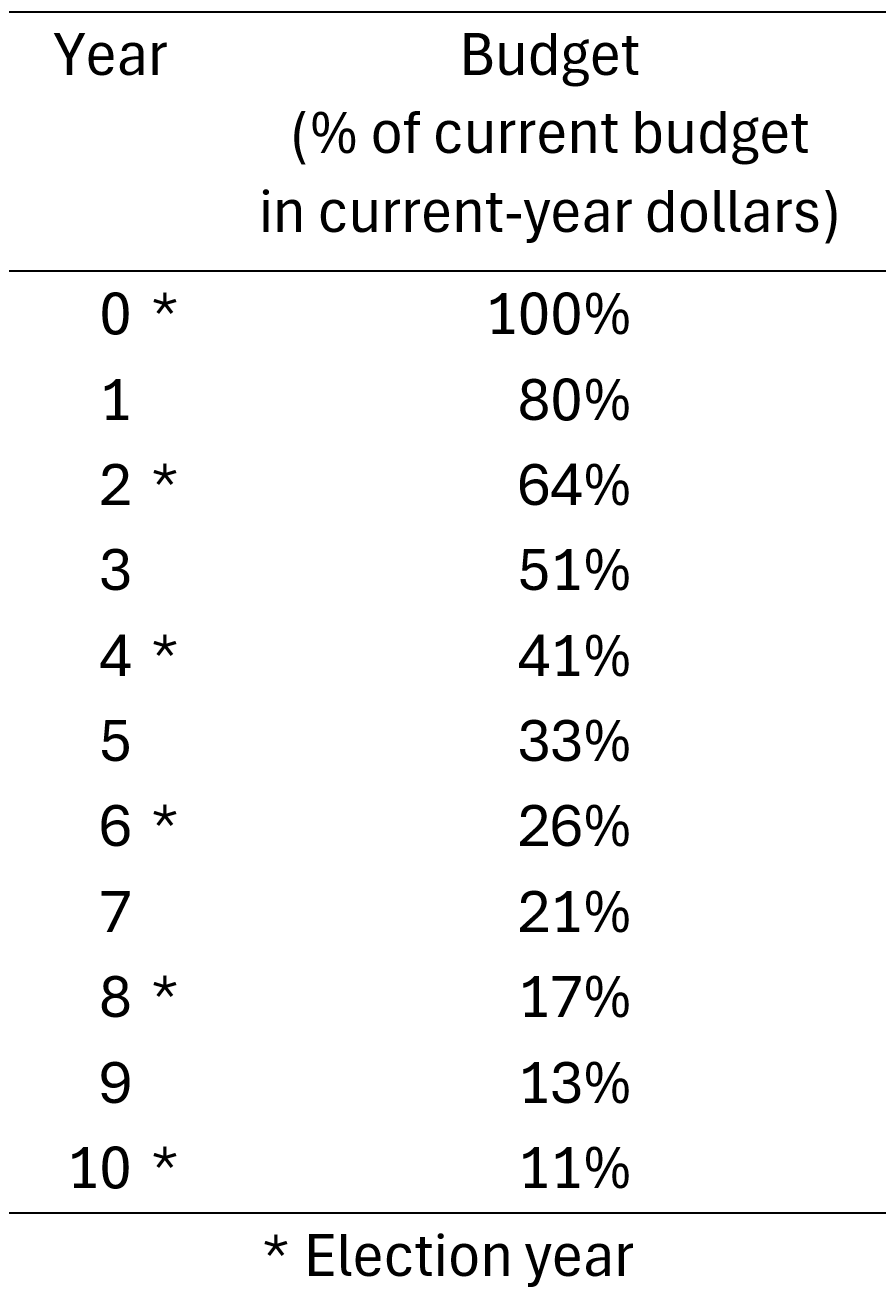
Enter The 20% Plan [23]:
Table. The 20% Plan
Governments’ taking and spending always reduces the general welfare [24], because government force always prevents individuals from making choices freely [25]. What’s optimal is to support people’s freedom [26] to add value themselves [27] by making full use of their own concentrated self-interest, superior local knowledge [28], and superior ingenuity.
It’s destructive, then, that nearly all spending is unconstitutional. It’s best that stripping away nearly all spending is each politician’s constitutional duty.
Committing to only strip away a minimum of 20% a year is a minimal commitment.
But crucially, this commitment is something that each politician can follow through on quite simply. Each legislator can simply vote no on any budget total that exceeds the nominal spending listed in The 20% Plan. Each executive can simply return with an objection [29] any budget bill whose total exceeds the minimum reductions in The 20% Plan.
Commitment to The 20% Plan should start today.
Each constitutionalist legislator should vote no to any budget bill that would make the total budget exceed the first-year total in The 20% Plan. Each constitutionalist executive candidate should vow [30] to veto [31] any budget bill that would make the total budget exceed the first-year total in The 20% Plan.
Each vote of no will build evidence that voters can expect specific politicians to support the Constitution and end the tyranny. It will also build evidence that voters can expect every other politician to continue the tyranny.
A small but growing minority bloc immediately could and eventually will block new tyranny. Any current house or senate majority or any current executive has effective or explicit full veto power.
Voters need such a real choice for every office [4].
Activist media who support the Constitution [32] can relentlessly call for congressmen and presidents to end their tyrannical inflation by following this this one simple 20% Plan. Constitutionalist activists can think about how Progressive activists relentlessly call for politicians to produce their wrong major objectives [33]. They can see that it’s even easier to relentlessly call for action [34] to achieve a single right objective.
Activist politicians who support the Constitution can know upfront that when they end the longstanding inflation tyranny, they will get full credit for doing what’s right. They will end up credited with not only ending inflation, but also making dollars start buying increasingly more from then on [35].
To instead keep offering half-baked crumbs is the worst tyranny [36].
References
- Horowitz, Daniel. “Why Won’t Mike Johnson Draw the Line on Illegal Aliens?” Blaze Media, 24 June 2024, www.theblaze.com/columns/opinion/why-wont-mike-johnson-draw-the-line-on-illegal-aliens. Accessed 10 Oct. 2025.
- Natelson, Robert G., and Andrew T. Hyman. “The Constitution, Invasion, Immigration, and the War Powers of States.” British Journal of American Legal Studies, vol. 13, no. 1, Jan. 2024.
- Anthony, James. “Federally Driven Invasion Must Be Ended by State Laws and Enforcement.” Lew Rockwell, 2 Feb. 2024, www.lewrockwell.com/2024/02/james-anthony/federally-driven-invasion-must-be-ended-by-state-laws-and-enforcement/. Accessed 10 Oct. 2025.
- Anthony, James. “Voters’ Dilemma.” rConstitution.us, 17 June 2022, rconstitution.us/voters-dilemma/. Accessed 10 Oct. 2025.
- Anthony, James. “Money Inflation Is Baked In. Savers Need to Preserve Assets.” Mises Institute Power & Market Blog, 10 Mar. 2023, mises.org/power-market/money-inflation-baked-savers-need-preserve-assets. Accessed 10 Oct. 2025.
- Anthony, James. “Inflation’s Root Cause, Reagan’s Compromise, and Constitutionalists’ Solution.” rConstitution.us, 4 Feb. 2022, rconstitution.us/inflations-root-cause-reagans-compromise-and-constitutionalists-solution/. Accessed 10 Oct. 2025.
- Hülsmann, Guido. “The Cultural and Spiritual Legacy of Fiat Inflation.” Mises Daily Articles, 10 Feb. 2022, mises.org/library/cultural-and-spiritual-legacy-fiat-inflation. Accessed 10 Oct. 2025.
- Bennett, Anthony J. “1992: ‘It’s the Economy, Stupid!’” The Race for the White House from Reagan to Clinton, Palgrave Macmillan, 2013, pp. 123–59.
- Anthony, James. “Separate Powers Automatically Using Simple Rules.” Free the People, 10 June 2023, freethepeople.org/separate-powers-automatically-using-simple-rules/. Accessed 10 Oct. 2025.
- Anthony, James. “On the Reading of Old Constitutions.” rConstitution.us, 9 Oct. 2021, rconstitution.us/on-the-reading-of-old-constitutions/. Accessed 10 Oct. 2025.
- Blackstone, William. Commentaries on the Laws of England in Four Books. 1753. Notes edited by George Sharswood, vol. 1, 1893. The Online Library of Liberty, 2011, p. 56.
- The Bible. Christian Standard Bible, Holman Bible Publishers, 2017, Romans 13:9.
- Anthony, James. “The First 1,461 Days of a Constitutionalist President.” rConstitution.us, 8 Jan. 2021, rconstitution.us/the-first-1461-days-of-a-constitutionalist-president/. Accessed 10 Oct. 2025.
- USA Constitution, art. II, sec. 3.
- Anthony, James. “Triage and Repeal.” rConstitution.us, 8 Apr. 2022, rconstitution.us/triage-and-repeal/. Accessed 10 Oct. 2025.
- Anthony, James. “Do You Support the Constitution? Take This Quiz and See.” rConstitution.us, 10 Dec. 2021, rconstitution.us/do-you-support-the-constitution-take-this-quiz-and-see/. Accessed 10 Oct. 2025.
- Anthony, James. “Progressives’ Rebellion Should Be Repudiated, Starting in States or County Regions.” Free the People, 14 Mar. 2025, freethepeople.org/progressives-rebellion-should-be-repudiated-starting-in-states-or-county-regions/. Accessed 10 Oct. 2025.
- Anthony, James. “The True Tax.” rConstitution.us, 27 Oct. 2021, rconstitution.us/the-true-tax/. Accessed 10 Oct. 2025.
- Anthony, James. “Your Future Earnings Are Quickly Becoming Other People’s Money.” The Federalist, 8 Sep. 2020, thefederalist.com/2020/09/08/your-future-earnings-are-quickly-becoming-other-peoples-money/. Accessed 10 Oct. 2025.
- Anthony, James. “Outgrow Entitlements: Stop Losses, Cover Debts, and Help More.” Mises Institute Power & Market Blog, 22 Apr. 2022, mises.org/power-market/outgrow-entitlements-stop-losses-cover-debts-and-help-more. Accessed 10 Oct. 2025.
- Anthony, James. “Productive Property Adds Value for Everyone.” rConstitution.us, 20 Nov. 2020, rconstitution.us/productive-property-adds-value-for-everyone/. Accessed 10 Oct. 2025.
- Anthony, James. “Changing Government by Stepping, Phasing, or Doing.” rConstitution.us, 23 Apr. 2021, rconstitution.us/changing-government-by-stepping-phasing-or-doing/. Accessed 10 Oct. 2025.
- Anthony, James. “Commissions Represent Congresspeople, Not the People.” Lew Rockwell, 15 Nov. 2023, www.lewrockwell.com/2023/11/james-anthony/commissions-represent-congresspeople-not-the-people/. Accessed 10 Oct. 2025.
- USA Constitution, preamble.
- Anthony, James. “The Forgotten Customers.” rConstitution.us, 4 Nov. 2022, rconstitution.us/the-forgotten-customers/. Accessed 10 Oct. 2025.
- Anthony, James. “Socialism Kills Freedom.” rConstitution.us, 21 July 2025, rconstitution.us/socialism-kills-freedom/. Accessed 10 Oct. 2025.
- Bylund, Per. How to Think about the Economy: A Primer. Mises Institute, 2022.
- Hayek, Friedrich August. “The Use of Knowledge in Society.” The American Economic Review, vol. 35, no. 4, Sep. 1945, pp. 519–
- USA Constitution, art. I, sec. 7, cl. 2.
- Anthony, James. “High-Reliability Self-Governance.” rConstitution.us, 23 Sep. 2022, rconstitution.us/high-reliability-self-governance/. Accessed 10 Oct. 2025.
- Magliocca, Gerard. “Veto! The Jacksonian Revolution in Constitutional Law.” Nebraska Law Review, vol. 78, no. 2, 1999, pp. 205–
- Anthony, James. “How the Media Can Increase Freedom.” rConstitution.us, 26 Nov. 2021, rconstitution.us/how-the-media-can-increase-freedom/. Accessed 10 Oct. 2025.
- Anthony, James. “The Deep State Consists of Every Progressive.” Free the People, 23 June 2023, freethepeople.org/the-deep-state-consists-of-every-progressive/. Accessed 10 Oct. 2025.
- Anthony, James. “Conservatism Is Action Conserving and Building Freedom.” rConstitution.us, 17 Sep. 2021, rconstitution.us/conservatism-is-action-conserving-and-building-freedom/. Accessed 10 Oct. 2025.
- Anthony, James. “Our Economy Needs a Good Dose of Customer-Driven Deflation.” Mises Institute Power & Market Blog, 21 May 2022, mises.org/power-market/our-economy-needs-good-dose-customer-driven-deflation. Accessed 10 Oct. 2025.
- Anthony, James. “Republicans: The Key Progressives.” rConstitution.us, 21 Aug. 2020, rconstitution.us/republicans-the-key-progressives/. Accessed 10 Oct. 2025.
James Anthony is an experienced chemical engineer who applies process design, dynamics, and control to government processes. He is the author of The Constitution Needs a Good Party and rConstitution Papers, the publisher of rConstitution.us, and an author in The Hill, Daily Caller, Blaze Media, Western Journal, American Thinker, The Federalist, Foundation for Economic Education, Lew Rockwell, Mises Institute, American Greatness, Free the People, and Lincoln Memorial University Law Review. For more information, see his about page, one-sheet, overview, and Fresh Takes on the Constitution.
Commenting
- Be respectful.
- Say what you mean.
Provide data. Don’t say something’s wrong without providing data. Do explain what’s right and provide data. It’s been said that often differences in opinion between smart people are differences in data, and the guy with the best data wins. link But when a writer provides data, the writer and the readers all win. Don’t leave readers guessing unless they go to links or references. - Credit sources.
Provide links or references to credit data sources and to offer leads.