Freedom Requires Responsible Action—Above All, Interposition
Take responsibility. Build up the infrastructure for freedom.
James Anthony
October 16, 2025
Freedom has developed in a series of steps. Today we’re so immersed in freedom’s infrastructure that we barely see, barely appreciate, and don’t conserve this infrastructure.
Individual defense, both self-defense and the defense of other individuals, has been a fundamental need [1] from the start. The securing of individual defense reached a local high-water mark much later with the Second Amendment. The Second Amendment has long been under constant siege by socialists, who in the USA masquerade as Progressives.
Value-adding has always been needed. Improvements were made in many steps, both in producing products to meet people’s needs and wants, and in building up and sharing knowledge [2]. Customers’, savers’, and producers’ free choices are what add value [3], and what are attacked and taken away by socialists [4], [5].
Families emerged as the bedrock social organization, which provides each of its members strong support that helps meet their deepest needs and wants. The family is attacked by socialists.
The Bible preserved key knowledge of God, history, human behavior, and wisdom. Jesus’s sacrifice enabled people to grow closer to God despite their past sins and further sins [6]. Translating and printing the Bible helped more people more thoroughly [7]. God and the Bible are attacked by socialists.
Christian churches, like their progenitors, Jewish synagogues, provided teaching and community that further helped people grow closer to God. Churches and synagogues are attacked by socialists.
Interposition came when individuals were protected against greater magistrates by lesser magistrates using their powers [8]. This was facilitated by lesser magistrates having ways they could defend individuals; building power, often by value-adding; and pursuing personal salvation and closeness to God, which kept in check their envy and ultimately led them to choose to protect others despite great dangers to their own lives, liberty, and property.
Interposition is systematically blocked by socialists. Socialists never interpose themselves, and socialists significantly limit lesser magistrates’ abilities to interpose themselves. Socialists limit lesser magistrates by organizing and controlling parties, governments, unions, corporations, and other organizations.
Secular institutions developed additional decentralized power that strengthened individuals in individuals’ competitions with governments [9]. Secular institutions are increasingly organized by or hijacked by socialists and then controlled by socialists.
Contracts—enforced at first by cooperation among value-adders, such as merchants [10], and enforced later by governments that supported common law—helped value-adders satisfy their own wants in additional ways by collaborating more-deeply with others. Contracts are coopted by socialists, through demanding and threatening to forcibly require actions that socialists labeled as equaling diversity, equity, inclusion, and more.
Joint-stock companies further increased the abilities of value-adders to satisfy their own wants by employing savings to satisfy customers [11]. Businesses, companies, and corporations are falsely maligned as uniquely self-interested and exploitive, by the antisocially self-interested socialists [12].
Insurance took the risk protection provided by joint ownership of stocks and spread it among larger, more-diversified groups of individuals. Loss prevention and loss mitigation aren’t targeted specifically by socialists. Instead, socialists promise to provide insurance themselves, and promote these plans not by allaying fears but by stoking fears.
Rather than reducing individual risks through individual defense, socialists support national defense, which ideally would be insurance. National defense weakens free people by setting aside massive resources for wars [13], and then brings on wars that aren’t needed for defense from direct attacks [14].
Rather than reducing individual health risks through individual prevention and therapy, socialists support public-health coercions [15]. Public health again weakens free people, here by interfering with free people using all available information and making their own best judgments of how to allocate personal resources to limit and mitigate personal risks [16].
In all, the infrastructure for freedom that we see in action all around us as part of ordinary life provides an extraordinary, rich set of capabilities. This infrastructure is under sustained, multipronged attack by socialists. And these capabilities have been overpowered by socialists in large regions, for as long as a natural lifetime, already—even without access to modern productivity, computers, and communications, which are even harder for individuals to defend themselves against.
Individual development, left to its natural course, has been described as following the doom loop [17].
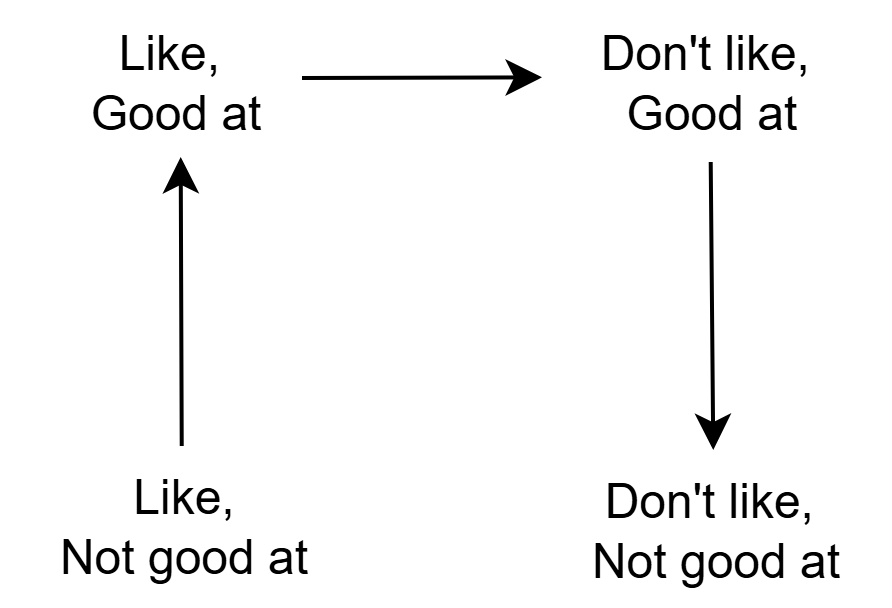
Figure. The Doom Loop
In a doom loop, an individual starts out interested in a task and not good at it. First he stays interested and gets good at it. Next he gets uninterested if he keeps doing it. Finally he stays uninterested and ends up no longer good at it.
For an individual, the trick is to bypass this natural course by finding new tasks he’s interested in and getting good at these tasks.
Societies seem to also follow a doom loop; but societies are different than individuals. The individuals who make up a society continually change, and the new, young individuals don’t start out good at the tasks the older individuals were good at. Infrastructure must be maintained. Where infrastructure has been degraded, it must be rebuilt.
Our wealth of infrastructure for freedom has many parts, including individual defense, value-adding, families, the Bible, Christian churches, interposition, secular institutions, contracts, joint-stock companies, insurance. All parts of our infrastructure are helpful, but few parts need to be the focus of renewed development.
The key destroyers are socialists and governments. To counter them, the key renewals have to be to build up families, personal Bible study, Christian churches, and their sorely-needed product, interposition. Interposition is what limits socialists and governments.
Tell your family members you love them. Tell God you love Him. Pray about everything. Look for leaders who interpose themselves for others [18]. Look to yourself to interpose for others. These are the key steps needed to build freedom.
References
- Caplan, David I. “Gun Control Jeopardizes All Our Constitutional Rights.” Journal on Firearms and Public Policy, vol. 3, 1990, pp. 57–
- Anthony, James. “Economic Growth Is a Natural Effect of Christianity.” rConstitution.us, 3 Dec. 2021, rconstitution.us/economic-growth-is-a-natural-effect-of-christianity/. Accessed 16 Oct. 2025.
- Anthony, James. “Genuine Recovery Is Up to Investors, Producers, and Consumer Choice.” Mises Wire, 27 Sep. 2022, mises.org/wire/genuine-recovery-investors-producers-and-consumer-choice. Accessed 16 Oct. 2025.
- Anthony, James. “Who Decides: Cronies, or Customers?” rConstitution.us, 28 May 2021, rconstitution.us/who-decides-cronies-or-customers/. Accessed 16 Oct. 2025.
- Anthony, James. “The True Tax.” rConstitution.us, 27 Oct. 2021, rconstitution.us/the-true-tax/. Accessed 16 Oct. 2025.
- Lewis, C. S. Mere Christianity. 1952. Samizdat, 2014.
- Eisenstein, Elizabeth L. The Printing Press as an Agent of Change: Communications and Cultural Transformations in Early Modern Europe. Cambridge University Press, 1979, p. 366.
- Anthony, James. “High-Reliability Self-Governance.” rConstitution.us, 23 Sep. 2022, rconstitution.us/high-reliability-self-governance/. Accessed 16 Oct. 2025.
- Adorney, Julian. “Private Institutions Are Not the Enemy of Libertarianism.” Mises Wire, 1 Aug. 2022, mises.org/mises-wire/private-institutions-are-not-enemy-libertarianism. Accessed 16 Oct. 2025.
- Benson, Bruce L. “The Spontaneous Evolution of Commercial Law.” Southern Economic Journal, vol. 55, no. 3, Jan. 1989, pp. 644–
- Economou, Emmanouel-Marios Lazaros, and Nicholas Kyriazis. “The Emergence of the Joint-Stock Companies in the Dutch Republic and Their Democratic Elements in Business.” MPRA Paper No. 91447, 10 Jan. 2019, mpra.ub.uni-muenchen.de/91447/1/MPRA_paper_91447.pdf. Accessed 16 Oct. 2025.
- Rectenwald, Michael. “The Great Leap Backward.” Mises Wire, 27 Dec. 2022, mises.org/mises-wire/great-leap-backward. Accessed 16 Oct. 2025.
- Anthony, James. “Limiting War through Good Boundaries: Secrecy, Independence, Basing, ROE Cards, Declarations, Enemy Governments, Productivity.” rConstitution.us, 24 Sep. 2021, rconstitution.us/limiting-war-through-good-boundaries-secrecy-independence-basing-roe-cards-declarations-enemy-governments-productivity/. Accessed 16 Oct. 2025.
- Anthony, James. “Biases Favoring War Are Overcome by Having Good Boundaries.” rConstitution.us, 5 Nov. 2021, rconstitution.us/biases-favoring-war-are-overcome-by-having-good-boundaries/. Accessed 16 Oct. 2025.
- Anthony, James. “Private Health.” rConstitution.us, 18 Mar. 2022, rconstitution.us/private-health/. Accessed 16 Oct. 2025.
- Anthony, James. “The Use of Knowledge in Pandemics.” rConstitution.us, 19 Feb. 2021, rconstitution.us/the-use-of-knowledge-in-pandemics/. Accessed 16 Oct. 2025.
- Hollander, Dory. The Doom Loop System: A Step-By-Step Guide to Career Mastery. Viking, 1991.
- Anthony, James. “Why DeSantis Matters.” rConstitution.us, 30 July 2021, rconstitution.us/why-desantis-matters/. Accessed 16 Oct. 2025.
James Anthony is an experienced chemical engineer who applies process design, dynamics, and control to government processes. He is the author of The Constitution Needs a Good Party and rConstitution Papers, the publisher of rConstitution.us, and an author in The Hill, Daily Caller, Blaze Media, Western Journal, American Thinker, The Federalist, Foundation for Economic Education, Lew Rockwell, Mises Institute, American Greatness, Free the People, and Lincoln Memorial University Law Review. For more information, see his about page, one-sheet, overview, and Fresh Takes on the Constitution.
Commenting
- Be respectful.
- Say what you mean.
Provide data. Don’t say something’s wrong without providing data. Do explain what’s right and provide data. It’s been said that often differences in opinion between smart people are differences in data, and the guy with the best data wins. link But when a writer provides data, the writer and the readers all win. Don’t leave readers guessing unless they go to links or references. - Credit sources.
Provide links or references to credit data sources and to offer leads.